
In human history, some of the most monumental discoveries were never planned on a blueprint; they erupted from pure, unexpected chance. Microwave ovens were invented when an engineer noticed a chocolate bar melting in his pocket near a radar tube; Penicillin was discovered because a petri dish was accidentally left exposed to mold spores.
In the world of interactive entertainment, the most successful open-world action franchise of all time—Grand Theft Auto (GTA)—was born out of a virtually identical stroke of bizarre fate.
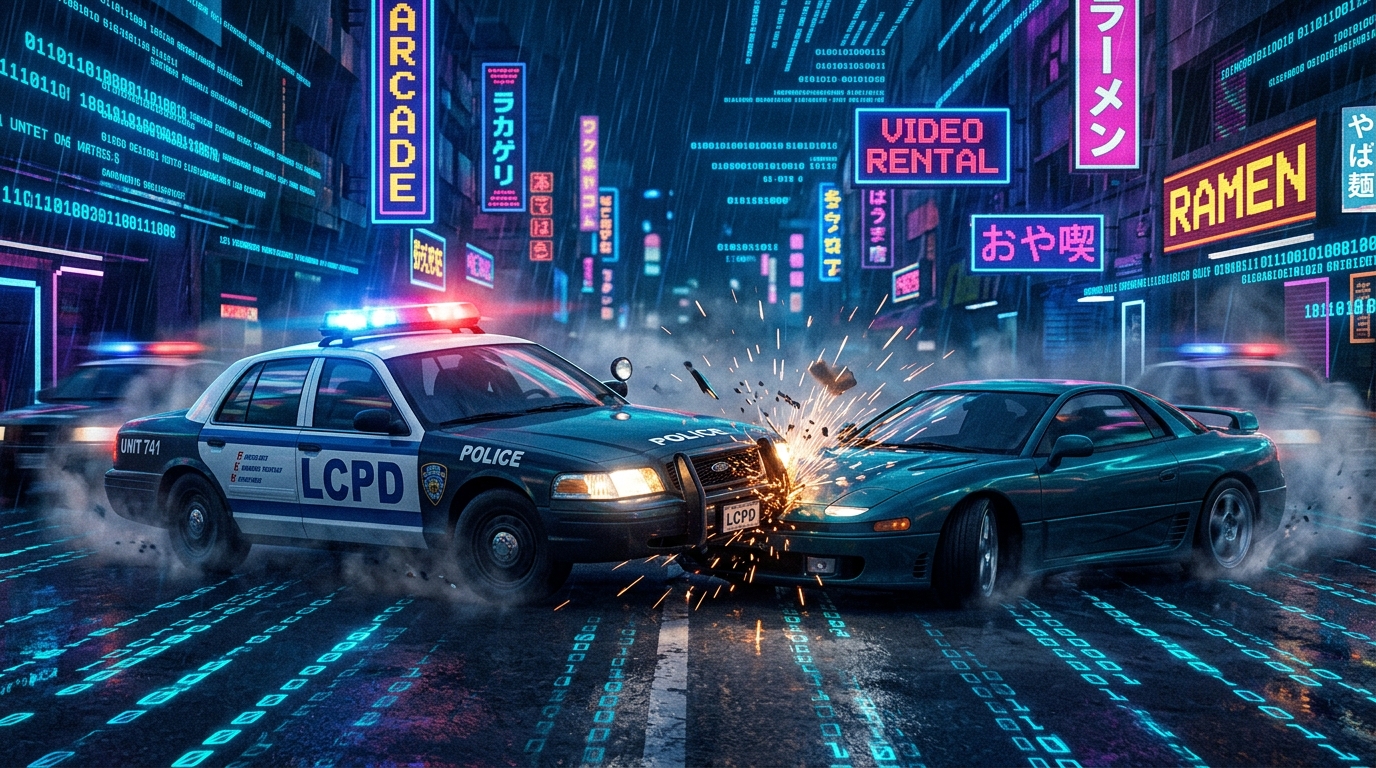
Had a specific police AI pathfinding bug not turned peaceful, law-enforcing cop cars into unhinged, violent ramming machines back in 1995, the world would likely never have witnessed CJ, Tommy Vercetti, Trevor Philips, or Rockstar Games' staggering $8.5+ billion gaming empire.
1. 1995: The Boredom of Race 'n' Chase at DMA Design
The story of GTA begins in Dundee, Scotland, in the mid-1990s. A small, ambitious video game development studio named DMA Design (the company that would later become Rockstar North), led by founder David Jones and lead programmer Mike Dailly, began working on a new top-down title for MS-DOS, Windows 95, and the original PlayStation.
The working title of the project was: Race ’n’ Chase.
Envisioned as a conventional 2D top-down driving game, players could choose between two opposing factions: Cops arresting criminals, or Robbers carrying out bank heists. Gameplay revolved around driving along linear city streets, observing traffic laws, avoiding collisions, and completing timed, objective-based missions.
However, internal playtesting proved to be a disaster. The game suffered from technical instability, constant crashes, and worst of all: It was profoundly boring. Gary Penn—former Creative Director at BMG Interactive—later recalled that the project was on the verge of total cancellation because test players found the gameplay utterly dull.
2. The Glitch: When Police AI Lost Its Mind (The "Psycho Cop" Bug)
Just as the project was spiraling toward cancellation, an unexpected coding error occurred within the artificial intelligence (AI) pathfinding routines controlling the police vehicles.
Under the original design specifications, when a player committed a crime, the AI cop cars were supposed to smoothly pursue the player, pull up alongside or in front of their vehicle, and trigger a routine traffic stop or arrest sequence.
Instead, a critical bug in the collision and pathfinding code caused the AI logic to malfunction completely. Rather than matching speed or pulling over, the AI police cars began driving straight through the player's vehicle at maximum speed with zero regard for self-preservation!
Police cars transformed into hyper-aggressive, kamikaze-like metal battering rams. They slammed into the back of player vehicles at full throttle, flipped cars across intersections, and triggered chaotic, explosive multi-car pileups across the city grid.
🎙️ Direct Quote from Gary Penn (Gamasutra Interview, 2011):
"Then one day, I think it was a bug, the police suddenly became mental and aggressive. It was because they were trying to drive through you. Their route finding was screwed I think and that was an awesome moment because suddenly the real drama where, 'Oh my God, the police are psycho -- they're trying to ram me off the road.' That was awesome, so [the cop bug] stayed in. It was tweaked a little bit, but that stayed in because that was great fun. Suddenly the game got more dramatic and it's no longer boring... Everybody suddenly went, 'Hey this is actually pretty cool...'"
3. The Bold Pivot: Ditching Traffic Laws for Open-World Crime
Realizing that the high-octane panic of surviving aggressive police chases triggered infinitely more adrenaline than obeying traffic laws ever could, the team at DMA Design made a historic pivot:
- Scrapped the Police Mode entirely: They eliminated the option to play as law enforcement.
- Replaced linear driving with open-world freedom: The focus shifted exclusively to playing as a criminal trying to evade an increasingly aggressive police force.
- Pioneered true sandbox freedom: Players were granted total freedom to step out of their vehicles, hijack any civilian car driving down the street, cause mayhem, and test their survival skills against relentless police pursuits.
The game was officially rebranded from Race ’n’ Chase to Grand Theft Auto (GTA) and released in 1997. When GTA 1 launched, it sent shockwaves through the gaming industry. For the first time, players were handed the keys to a living, breathing virtual city.
4. From 2D Pixels to an $8.5 Billion Cultural Juggernaut
From that singular broken line of code in 1995, the evolution of the GTA franchise went on to redefine modern entertainment:
- 2001 - Grand Theft Auto III: Made the legendary leap into full 3D graphics under Sam & Dan Houser and Leslie Benzies, laying the blueprint for modern 3D open-world game design.
- 2004 - Grand Theft Auto: San Andreas: Set in 1990s California amid the real-life L.A. Riots and Rampart scandal, becoming the best-selling PlayStation 2 game of all time (27.5+ million copies).
- 2013 - Grand Theft Auto V: Shattered 7 Guinness World Records, generating over $1 billion in revenue in just 3 days—becoming the fastest-selling entertainment product in human history.
To date, the Grand Theft Auto series has generated over $8.5 billion in lifetime revenue with more than 420 million copies sold worldwide. And every single dollar of that historical empire traces directly back to a single police AI bug written 30 years ago in Scotland.
🎯 Conclusion: The Ultimate Lesson for Game Developers
The birth of Grand Theft Auto offers a profound lesson for game developers and software engineers alike: Greatness often hides inside unexpected glitches.
If DMA Design had rigidly patched out that AI bug in 1995 to stick to their original, boring racing plan, gaming history would have lost one of its most defining masterpieces. Recognizing genuine fun, having the courage to abandon a bad plan, and turning a technical failure into a core feature is what turned a small Scottish studio into Rockstar Games.
📚 Verified Historical References:
- Gamasutra / Game Developer (2011): Gary Penn Interview on the Origins of Grand Theft Auto and the Race 'n' Chase Police Bug.
- DMA Design Official Archives (1995): Race 'n' Chase Original Design Document by Paul Farley & Mike Dailly.
- Eurogamer Retrospective (2012): The History of Rockstar North and how a bug created GTA.
- Take-Two Interactive SEC Filings & Guinness World Records Database: GTA V Lifetime Revenue & Sales Records.